
ActuaPlan Update v1.3 Multi-Currency simulation and Economic Scenario Generator
March 28, 2026
ActuaPlan v1.3 adds multi-currency simulation, helping people to model FX risk more realistically when assets and spending span different currencies.
TLDR
• 💵 Multi-Currency Simulation
Hi everyone,
We're introducing multi-currency simulation support in ActuaPlan.
For investors outside the US, I find common investment advices, like investing into the broad-equity market, assuming a 7% return, or applying 4% withdrawal rule overly simplistic and and often unhelpful. These ideas are heavily influenced by the historical experience of the US market. But for many people around the world, their local capital market do not behave like US market. For example,
- A Singapore investor buying a local broad-market ETF may think they are getting diversified exposure to their home economy, but in practice a large share of that exposure are concentrated in banks. In the Straits Times Index (STI), three major banks (DBS, OCBC and UOB) alone make up roughly half of the index. This creates a very different risk profile behind common US-centric advice.
- A Japanese investor who bought the Nikkei 225 a the end of 1989 had to wait until 2024 just to see the index close above its bubble-era peak.
- An European investor who invested in the S&P 500 at the end of 2016 would have earned about 19% in USD terms, but only around 5% in EUR terms because of exchange-rate movements.
Therefore, for people who hold assets in multiple-currencies, the FX risks is very real and important. This is why we built multi-currency simulation support in this update, following best practices in actuarial and finance industry to help simulate FX risk in long-term financial planning.
Multi-Currency model
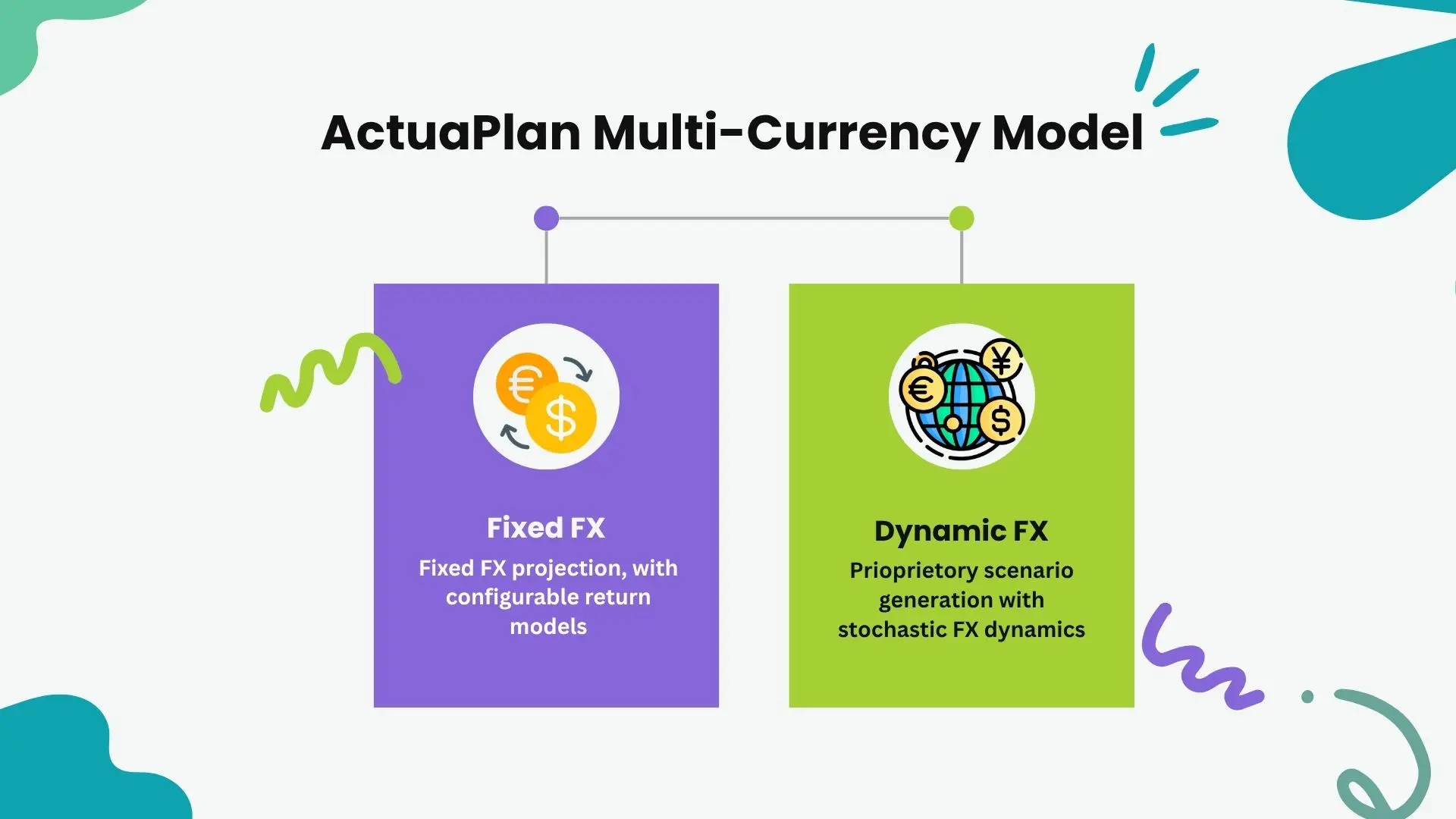
In ActuaPlan, there are currently two currency models: Fixed FX and Dynamic FX.
Currency icons by
Freepik / Flaticon
In Fixed FX, which is our default model:
- We specify the exchange rate at the start of the projection. This can be inferred automatically from our market snapshot or set by user input.
- That FX rate is then held constant throughout the projection.
- Users can still choose the return model for each asset class.
In Dynamic FX, our latest model:
- FX is simulated stochastically using our proprietary Economic Scenario Generator.
- This allows currency risk to be reflected directly in the projection results.
- Because of the current complexity of the model, the underlying ESG parameters are not yet exposed for user editing. For now, they are reviewed and updated by us every quarter.
So, which one should you choose?
- Fixed FX is better suited for users who want more control over their assumptions. Users can specify asset return models separately across currencies, and can adjust the parameters of the historical bootstrap or normal/lognormal models. This is useful for users who want to run their own market assumptions and manage FX risk manually through what-if scnearios.
- Dynamic FX is better suited for users who prefer a more hands-off default model. Here, FX risk is already incorporated into the simulation through our Economic Scenario Generator, and market return assumptions can differ by currency within that framework. The tradeoff is that, for now, users cannot directly edit the underlying ESG parameters.
**Why are the ESG parameters not editable yet? **In Dynamic FX, asset returns, exchange rates, and yield curves are generated jointly within the same scenario engine. Allowing users to tweak asset return assumptions in isolation, without also adjusting the corresponding FX and yield curve dynamics, would break the internal consistency of the model.
How to use it
To use multi-currency simulation in ActuaPlan, go to the Market Assumption & Risk advanced module. At the top of the section, you will now see a dropdown for selecting the simulation model:
- Return Distribution Model (Default), which uses a fixed FX rate throughout the projection
- ActuaPlan ESG Scenario Model, which uses dynamic FX rates generated by our Economic Scenario Generator
As usual, I'm happy to receive any feedback and suggestions to further improve the tool. Please don't hesitate to contact me directly via the feedback button located at the right of the ActuaPlan app.

About the author
Roen is a Fellow of the Society of Actuaries (FSA) and a Chartered Enterprise Risk Actuary (CERA) working in life insurance. His work focuses on Solvency II, capital management, and asset–liability management, with deep experience in financial and stochastic modelling. On this site, he uses the same actuarial tools applied in insurers to help individuals think more rigorously about retirement and long-term financial risk.